Casino Doctor or Military Medic: Two Different Story Jobs
Casino doctor versus military medic: shape a more credible scene by showing how privacy, teamwork and competing duties alter each character’s choices.
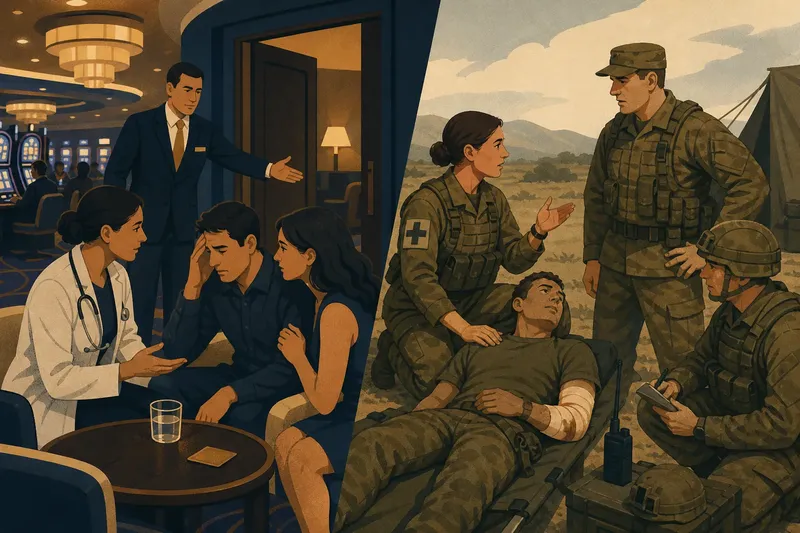
The common mistake in writing a casino doctor or military medic is to give each the same scene: an injury appears, the clinician treats it, and everyone moves on. That choice makes the setting feel interchangeable. Casino doctor versus military medic works better as a contrast between two kinds of interruption: one that unsettles a public venue and one that disrupts a group’s shared plans.
Casino doctor versus military medic changes the scene’s rhythm
A casino scene can slow around a guest who wants privacy, a companion who wants to stay, or staff trying to keep a route clear. The tension is social as much as clinical: who speaks, who waits, and what the guest is willing to share in a public place?
A military scene can move through coordination. A medic communicates what the person needs, a teammate takes on a task, and a leader responds to the effect on the group. The role becomes vivid through the sequence of decisions, not through a display of specialist vocabulary.
Think of a key and a radio left on a workbench: both are useful, but each changes what can happen next in a different way. A casino manager might offer access to a quieter room; a military colleague might relay information or help organise movement. Make each object prompt an action rather than serve as decoration.
A casino doctor’s scene can hinge on consent and access
Give the guest a concern that is theirs, not merely an obstacle to the venue’s routine. They might ask for a companion to remain close, hesitate to move, or want to know who will hear what they say. The doctor’s response can show attention to that concern without suggesting that every casino employs clinicians in the same way.
Separate practical venue decisions from clinical ones. Staff can offer a quieter space or help keep an area clear; the doctor can explain what they need from the guest. This division gives the manager and clinician different reasons to speak, while leaving the guest room to agree, question or refuse.
Say you are writing an invented lounge scene: one guest is confused, one companion asks to stay, and one manager offers a private room. The doctor asks the companion to remain nearby, requests space to speak with the guest, and asks staff to seek suitable outside assistance. The visible result is a clearer division of tasks; the guest’s condition remains unresolved, so the scene does not claim a cure or imply a standard casino procedure.
A military medic’s scene can hinge on communication
Give the medic a responsibility that affects what another person does. They might tell a leader that the person needs further care, ask a teammate to accompany them, or explain why the group must pause. A short, plain statement can carry authority because it changes the team’s next action.
Be precise about the character’s service, country and period when a title or duty matters to the plot. “Medic”, “doctor” and “military clinician” can refer to different roles, and their meaning depends on the setting. If a procedure or title is central, verify it against a reliable source for that specific context; if it is not, ordinary language may keep the scene clear without implying a historical fact.
Imagine an invented field scene with three people: a medic, an injured colleague and a team leader. The medic assesses the colleague, tells the leader that further care is needed, and asks a teammate to accompany the person; the leader then decides who will go and who will remain. The observable outcome is a named task for each person, while the exact care and movement remain part of the story’s established circumstances.
Use details that force a choice
A radio, a screened-off lounge or a manager’s request earns its place when it changes what someone says or does. So does a teammate relaying information or a leader asking who can accompany a colleague. If a detail changes no decision, it may be atmosphere rather than part of the scene’s action.
Use these checks to connect what the reader can observe with a character’s next choice:
- Check whether the person receiving care states a concern; if they do, have the clinician address it, but if they do not, give them a concrete question or request.
- Check whether a manager asks for practical coordination or private information; if the request is practical, show a relevant response, but if it seeks private details, show the clinician setting a boundary.
- Check whether venue activity interrupts the conversation; if it does, have staff manage the space, but if it does not, keep the exchange focused on the guest and clinician.
- Check whether the medic has a defined team responsibility; if they do, show them communicating it, but if they do not, establish who is present and give the medic a clear task.
- Check whether a leader’s request changes care or movement; if it does, let the medic explain the consequence, but if it does not, remove the dialogue or make its effect explicit.
- Check whether a title or procedure depends on a service or period; if it does, verify it for that setting, but if it does not affect the plot, use plain language instead.
Which role fits the conflict you want to write?
What does a casino doctor do in a story?
The character brings a health concern into a venue where privacy, public attention and staff coordination may matter. Define the doctor’s responsibilities for the fictional setting instead of treating one employment arrangement as universal.
Is a military medic the same as a military doctor?
Not necessarily: those terms can describe different roles, and their meanings vary by country, service and period. Establish the character’s training and duties, then keep the title consistent with what the character does.
Can one character plausibly work in both settings?
Yes, if the story explains why the person is present and what role they hold in each place. A military clinician visiting a casino as a civilian, for instance, does not automatically have authority over venue staff.
How can a writer show medical authority without technical dialogue?
Let the character explain a decision in everyday language, request a specific action or set a boundary. Show how the guest, colleague or manager responds so the reader can see the decision’s effect.
Let each character’s limits shape what happens next
A casino doctor may ask for privacy without controlling how the venue responds. A military medic may explain what a colleague needs without deciding every part of the group’s movement. These limits create room for other characters to accept, question or complicate the clinician’s request.
For a casino doctor versus military medic scene, make the next beat follow from that response: the guest might agree to speak in private, or the leader might assign someone to accompany the injured colleague. The role feels specific when its choices alter who acts next, even when the clinician cannot settle the whole situation.