Gambling Odds and Medical Risk in a Military-Medicine Scene
Gambling odds and medical risk answer different questions. Shape a military-medicine scene that keeps casino tension while showing a responsible response to illness.
The common mistake in writing gambling odds and medical risk is to make a card result explain a person’s condition. In a military-medicine scene, that shortcut can flatten both the game and the medic’s work: a wager follows its rules, while care begins with the person in front of the clinician.
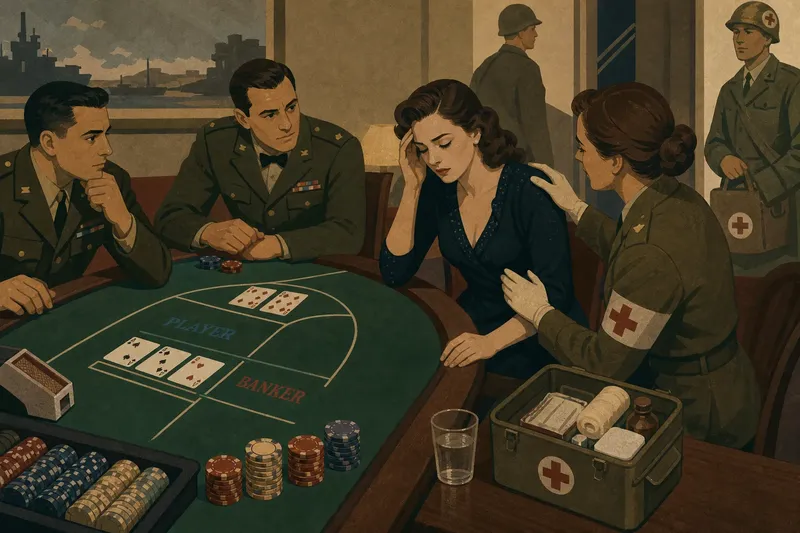
Say a fictional military museum stages a casino scene in a barracks recreation room. Mara, a visiting performer, loses a hand of baccarat and then appears pale and unsteady; the medic’s next action should respond to what is observable, not treat the loss as a diagnosis or prediction.
Give the game and the medical response separate jobs
Gambling odds describe outcomes within a game’s rules: which hand wins, how a bet is settled, or what result follows a particular play. Probability and odds are related mathematical ideas, though they express uncertainty differently; in casual speech, “odds” may simply mean a chance of success.
Medical risk concerns possible harm to a person, considered in context. It is not a diagnosis, and a visible sign alone does not establish its cause. In fiction, the medic can recognise uncertainty, respond within their role and seek appropriate support without claiming more than the scene allows.
That distinction also sharpens characterisation. A medic who sets aside the table’s drama to check on Mara shows professional attention; a character who calls her condition “bad luck” reveals a belief, not medical knowledge.
Build military context through role, setting and limits
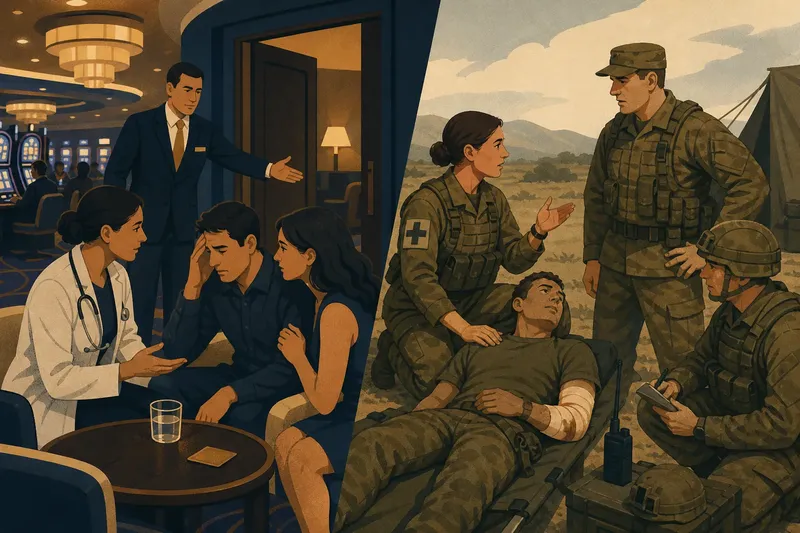
A military setting should affect the scene beyond its uniforms. Establish why a medic is present, whom they are responsible for, what support is available and what authority they have in that fictional setting. These details shape the response without requiring a lecture on medicine.
Historical period matters, too. A scene set in a particular era should not casually give its medic equipment, terminology or responsibilities from another time. If those details are central, verify them with reliable historical and professional sources; where the scene does not establish a medic’s scope, show them seeking suitable assistance rather than assigning specialist judgement.
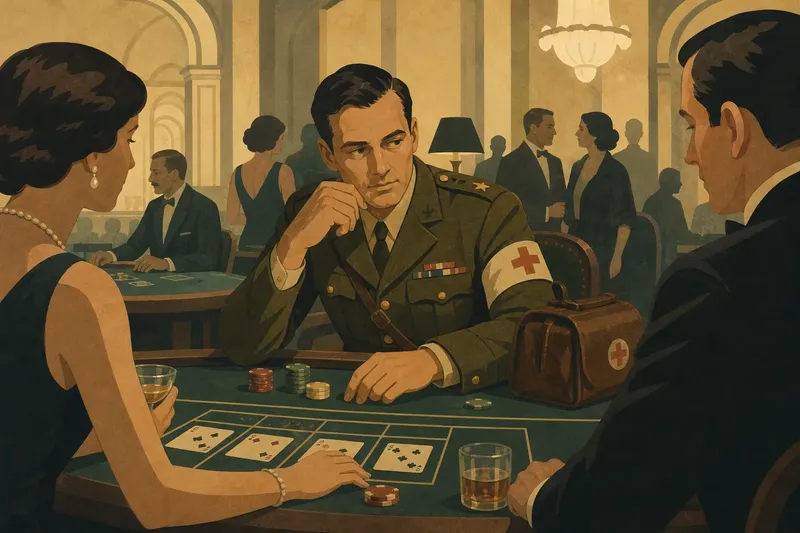
The casino can remain part of the military environment—a recreation room, a staged museum display or a private game among characters—without implying that gambling predicts health. Like a playing card placed beside a first-aid kit, the two objects share a table but serve different purposes.
Make each scene detail lead to a clear writing choice
Before revising the scene, check what each detail contributes. If an observation is unclear, sharpen what the character sees or hears; if a medical action exceeds the character’s established role, change the action or establish appropriate support.
- Game rules: Check which baccarat result the scene establishes; if the rules and outcome are clear, describe the hand as play, but if they are not, clarify the wager or remove technical detail.
- Observable change: Check what the medic can see or hear, such as Mara appearing pale or having difficulty standing; if a change is shown, describe it without assigning a cause, but if none is shown, do not invent a symptom to justify attention.
- Medic’s role: Check what the scene has established about the medic’s duties; if initial assistance is within that role, show an action consistent with it, but if a decision requires specialist judgement, bring in qualified support.
- Available help: Check whether the setting includes a route to further assistance; if it does, show the medic using it when needed, but if it is not established, clarify the fictional setting rather than presenting an unsupported resource as fact.
- Dialogue: Check whether “the odds are against her” expresses a character’s fear or claims to be clinical guidance; if it is metaphor, make the speaker’s attitude clear, but if it is meant as guidance, replace it with language grounded in the scene’s established assessment.
- Historical detail: Check whether the equipment, terminology and responsibilities fit the chosen period; if they are verified, retain them, but if they are uncertain, use less specific wording or seek qualified historical advice.
Imagine a fictional museum script starts with Mara losing one baccarat hand, the medic noticing two visible changes—pallor and unsteadiness—and the script establishing that the medic provides initial assistance while museum medical staff are available. The medic stops the game, checks whether Mara responds, then calls those staff; the expected observable result in the scene is that help arrives to assess her, while the cause remains undetermined. The trade-off is deliberate: the scene keeps the tension of the interrupted game but does not turn the hand into a medical forecast.
Show uncertainty through action rather than explanation
Let the game resolve at the table, then give the medic a distinct sequence of actions shaped by the setting and role. A pause in play, a clear request for help or a change in the room’s attention can carry the scene’s tension without having a character explain probability.
Dialogue can still use chance as metaphor. A soldier might say that a decision feels like a wager; the line conveys uncertainty or bravado, not a clinical comparison. Keep that distinction visible through the character’s context and the medic’s response.
What should writers clarify about chance and care?
Can a character say Mara has “bad odds”?
Yes, if the line is clearly an expression of fear, bravado or metaphor. If it is presented as clinical guidance, specify what health outcome is being discussed and who is assessing it.
Does a visible sign explain what caused it?
No single observation in a scene needs to settle the cause. Show what the medic notices and the reasonable next action within the role and setting, leaving diagnosis to an appropriate assessment.
How can a military setting affect the medic’s response?
It can shape responsibility, available support, authority and the practical environment. Establish those details for the chosen fictional period and setting rather than assuming every military medic has identical duties or resources.
How can the scene retain casino tension?
Let the interruption change the game’s rhythm: the cards remain on the table, but attention shifts to Mara and the call for help. That contrast preserves suspense without suggesting that the wager explains her condition.
Use gambling odds and medical risk for different kinds of uncertainty
Gambling odds can give a military-medicine scene atmosphere, conflict or a character’s chosen metaphor. Medical risk belongs to a different question: what may be happening to this person, and what response fits the established role and circumstances?
When revising gambling odds and medical risk in fiction, give the wager its own outcome and the medic’s actions their own purpose. The scene gains credibility when its tension comes from what the characters must do next, not from treating chance as a substitute for care.